
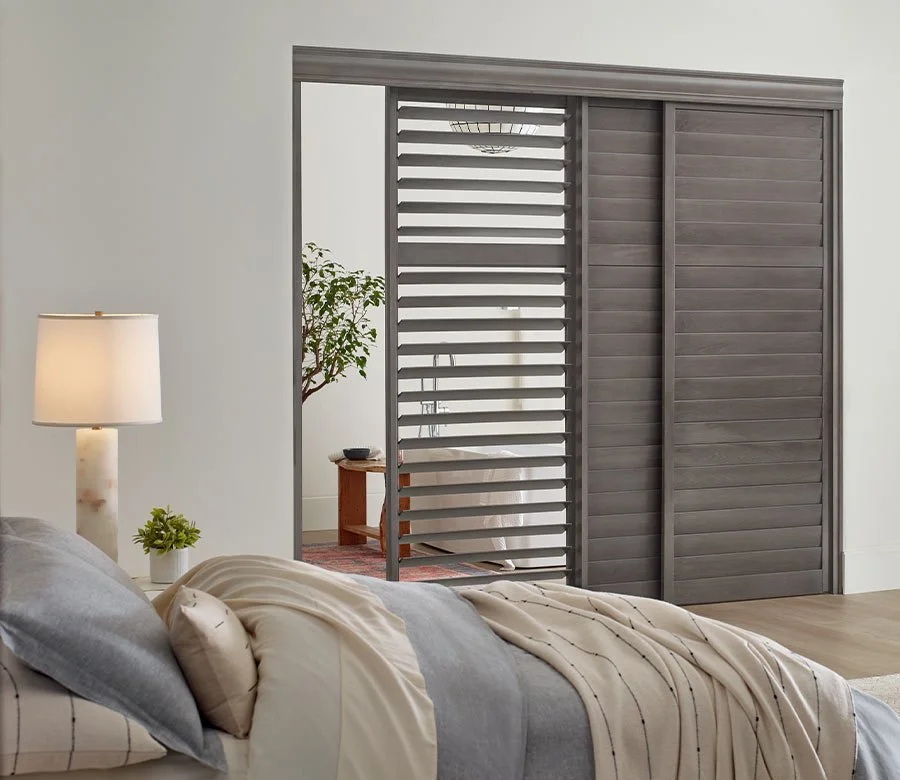
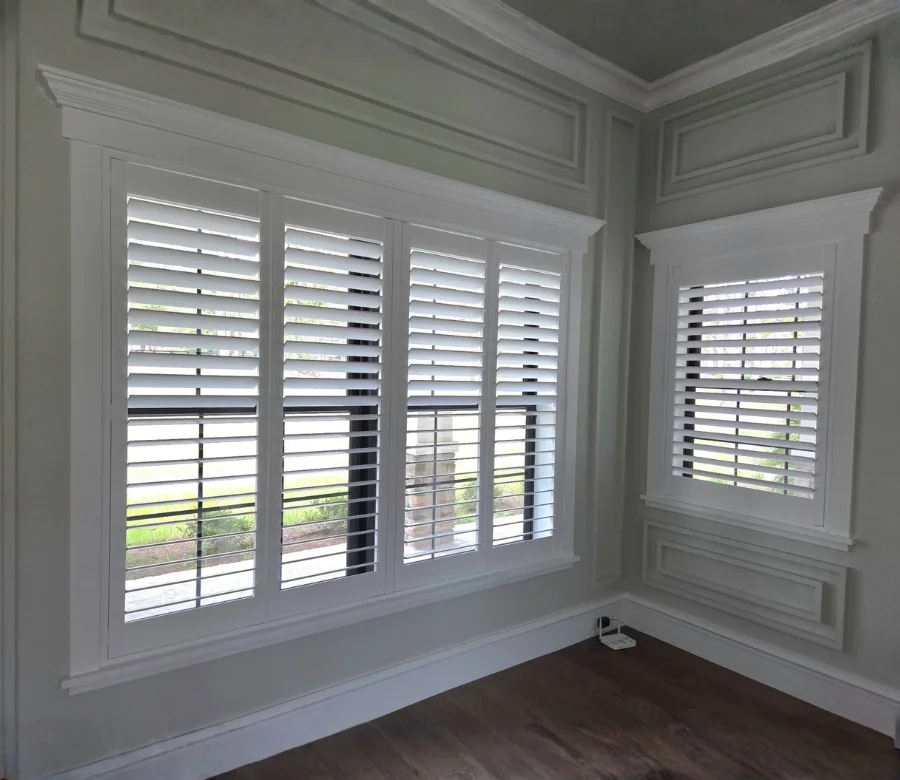
A plantation shutter is a solid interior window covering built as a rigid panel. There is a frame fixed around the window opening, vertical stiles and horizontal rails forming each panel, and wide horizontal louvers that pivot open and closed. The panels are hinged, so they swing rather than raise.
That last part is what separates a shutter from everything else on a window. A blind or a shade is an object sitting in the opening that you raise out of the way. A shutter is joinery attached to the house. We build and install plantation shutters across St. Petersburg, and the way clients talk about them gives it away: nobody says they are "putting up" shutters, they say they are "having them installed," the same way they would talk about cabinets.
The parts, and why each one matters
Once you know the anatomy, quotes and product pages stop being confusing.
- Frame. The outer piece fixed to the window opening or the surrounding wall. It hides the gap between the panel and the wall and gives the shutter its finished, built-in look. Frame style is why two shutters at the same price can look completely different.
- Stiles. The vertical members on each side of a panel. They carry the hinges and the louver pivots.
- Rails. The horizontal members at the top and bottom, and sometimes a divider rail across the middle. A divider rail lets the top and bottom halves of the shutter operate independently, so you can close the bottom for privacy from the sidewalk and leave the top open for light.
- Louvers. The horizontal slats that tilt. Everything about how a shutter performs comes back to these.
- Tilt rod. The mechanism that moves the louvers together. A traditional tilt rod runs down the center of the panel. A hidden tilt rod moves the linkage inside the stile, which clears the sightline and is what most people want on a window with a view.
Louver width changes the whole feel
Louvers come in three common widths: 2.5, 3.5, and 4.5 inches. The wider the louver, the fewer of them cross the panel, and the more open the window feels when they are tilted up.
This is the decision people most often get wrong. A 2.5 inch louver reads traditional and works on small or historic windows, but on a wide window it puts a lot of horizontal lines across the glass. A 4.5 inch louver on the same window feels closer to an open sightline. In a room that already feels dim, moving up a louver size does more for the light than changing the paint color.
Even fully open, a shutter still covers roughly a third of the window opening between the frame, the rails, and the louver edges. That is the tradeoff nobody mentions on the showroom floor, and it is worth knowing before you commit. If maximum light matters more than privacy in a given room, a roller or solar shade will serve you better there.
Basswood, faux wood, or composite
Three materials cover almost the whole market.
Basswood is real hardwood. It is light for its strength, which matters because a tall panel made of something heavy will sag on its hinges over the years. It takes paint and stain cleanly, so it is the pick when you want a specific finish or a stained wood look.
Faux wood is solid PVC or vinyl. It is waterproof, it does not warp, and you can wipe it down. In Florida that matters more than it does most places. Bathrooms, kitchens, laundry rooms, and any window that gets left open in August are faux wood territory. The tradeoff is weight, which limits how wide a single panel can span before you need to split it.
Composite is an engineered core with a hard exterior finish, landing between the other two on both price and moisture resistance.
Humidity and salt air do the deciding here more than style does. On the barrier islands and anywhere near the water, we lean faux wood or composite on the exposed side of the house and save basswood for the interior rooms. You can see the brands we work with, including Norman and Graber, on our brands page.
How panels are configured
The panel layout is the other half of the specification, and it is set by the opening rather than by taste.
- Hinged panels swing open like small doors. The standard for most windows.
- Bi-fold panels fold against each other, which keeps a wide opening from needing enormous swing clearance.
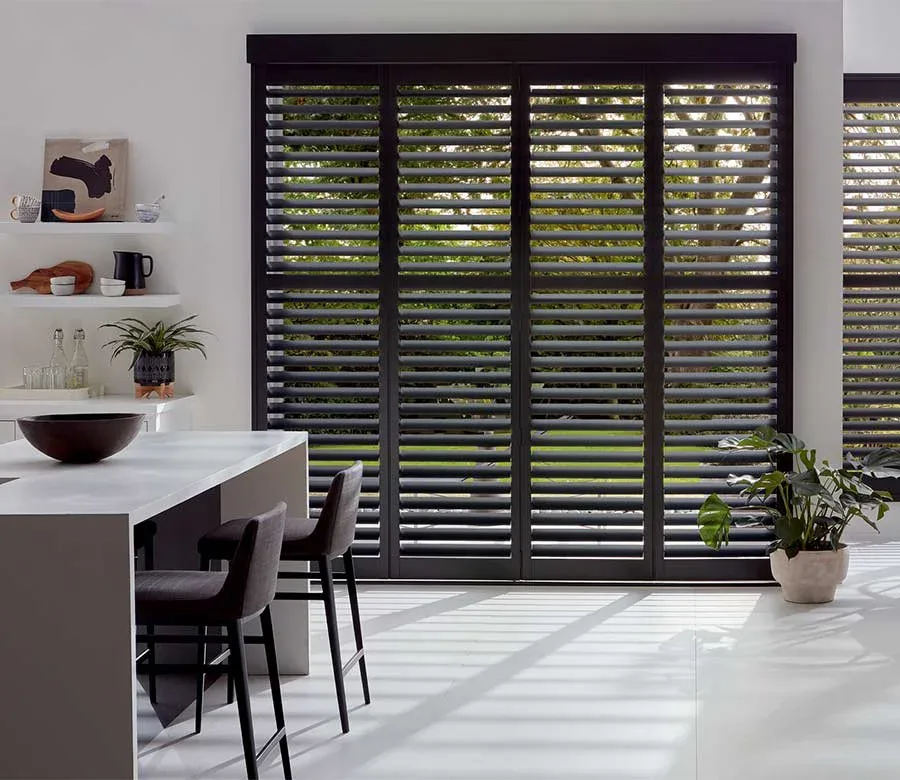
- Bypass panels slide on a track past one another, the usual answer for a sliding glass door or a wide patio slider.
- Cafe style covers only the lower half of the window, leaving the top bare for light. Common on street-facing windows in older neighborhoods.
Mounting matters too. An inside mount sits within the window opening and shows the trim, which looks cleaner when the opening is square and deep enough. An outside mount sits on the wall around the opening and is the fix for windows that are shallow or out of square, which describes a lot of older St. Petersburg housing stock. Deciding between them is a measurement question, not a preference, which is covered in our walkthrough of what actually happens during installation.
Where the name comes from
The style traces back to the wide-louvered shutters used on large houses in the American South and the Caribbean in the 18th and 19th centuries. Wide louvers moved more air and cut more overhead sun than the narrow slats common in Europe, which is exactly what you want in a hot, humid climate. The name now describes the wide-louver style rather than any particular maker or era.
Shutters compared to the alternatives
A shutter is not always the right answer, and knowing when it is not saves money.
Against blinds: shutters cost more, last far longer, and become part of the architecture. Blinds are cheaper, quicker, and easy to swap. On a rental or a house you are selling in two years, blinds usually win on math alone.
Against shades: a solar or roller shade disappears when raised, which is the argument for shades on a waterfront window where the view is the point. A shutter is always visible. Where the sun is the problem rather than the view, a shade or an exterior screen often does more for less.
Against drapery: fabric softens a room in a way a hard panel cannot. Plenty of rooms end up with both, shutters for the light and privacy, drapery for the warmth.
There is also a middle path people forget: shutters on the rooms that need privacy and sun control, motorized shades on the big sliders where you want the glass to clear completely. Doing one thing everywhere is how quotes get expensive without making the house better.
Cost, in the honest version
Custom plantation shutters generally run from a few hundred dollars to around a thousand per window installed. Faux wood on a standard rectangular window sits near the bottom. Basswood on a tall window, an arch, or an opening that needs several panels sits near the top.
The variables are material, louver size, how many panels the opening requires, specialty shapes, and the finish. Any quote given before someone has measured your windows is a guess. We break down local pricing in more detail in our guide to plantation shutter cost in St. Petersburg.
Living with them
Maintenance is dusting. Every louver is a flat surface, so a microfiber duster or a vacuum brush attachment once a month keeps them looking new. Faux wood takes a damp cloth. There are no cords to fray, no fabric to fade, and no mechanism that wears out, which is a large part of why a well-built shutter is still working after fifteen or twenty years.
If you want to see how different louver widths and finishes look in real rooms rather than in a catalog, our project gallery has installations across Pinellas County.
For a room-by-room read on where shutters make sense in your own home and where something else would serve you better, we do free in-home consultations across St. Pete, Clearwater, and Pinellas County. Schedule a consultation or call (727) 914-5410.
Questions About Your Project?
Call (727) 914-5410 or schedule a free in-home consultation.